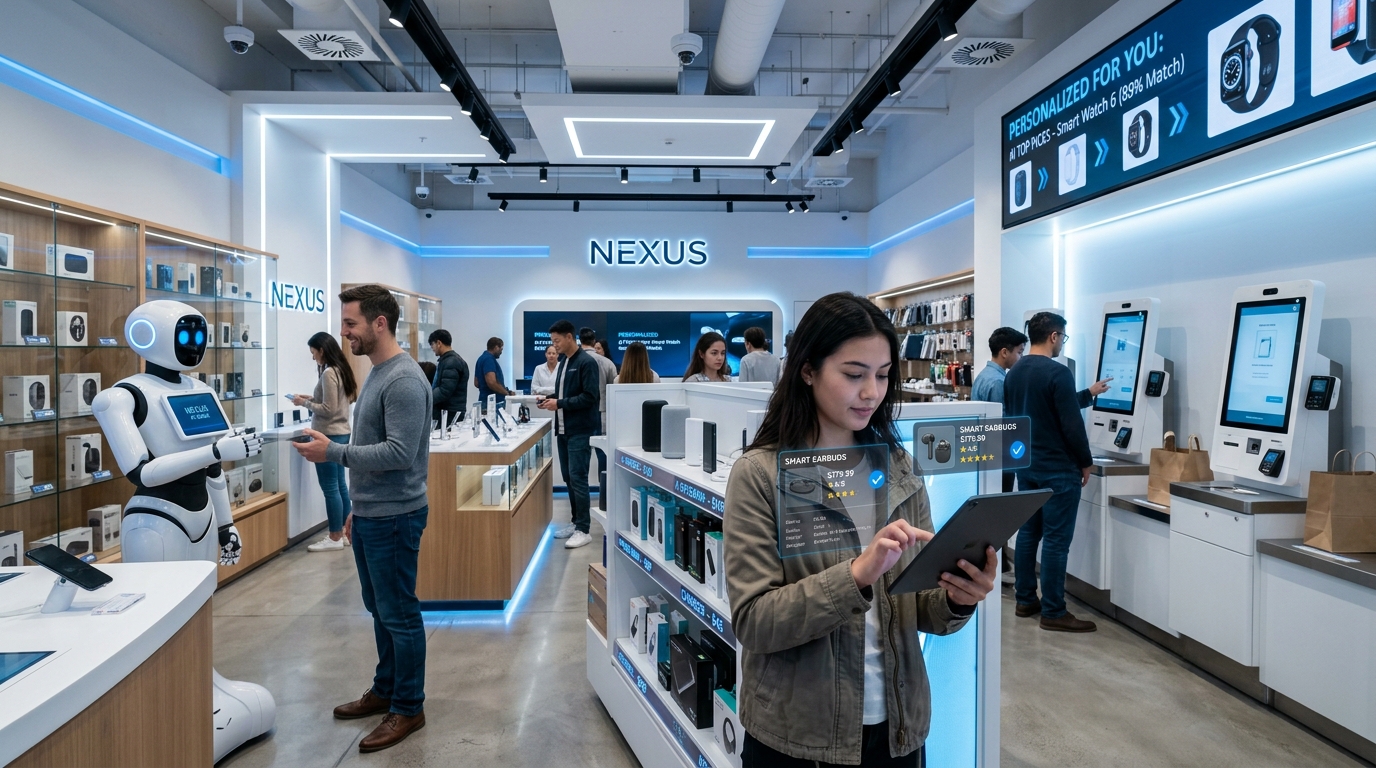
Chapitre 15 - AI & The Future of Retail
Intelligence artificielle et distribution.
Reading Comprehension
Based on the AI Commerce Rankings article from Découvrir. Answer in English.
New Rankings Rate AI Retail Readiness Across 1000 Companies
The #814 retailer by online sales just claimed the top spot in AI readiness in the AI Commerce Rankings, a new quarterly benchmark by Digital Commerce 360 and ReFiBuy.
"The Top 1000 has always been one of the most important scoreboards in ecommerce," said Scot Wingo, CEO and co-founder of ReFiBuy. "But AI shopping agents are already changing how shoppers find and evaluate products, and most retailers do not yet know whether their catalogs are ready. Estimated online sales show who won the last era of ecommerce. The AI Commerce Rankings show who is positioned to win the next one."
Each retailer receives a readiness score from zero to 100. Scores will be recalculated every quarter as catalogs and answer engines evolve.
ChatGPT accounts for more than 80% of AI-referred retail traffic in the first edition. Google Gemini, Alexa for Shopping and other emerging destinations are already influencing product discovery, and their share will change.
Across all 1,000 retailers, the average readiness score is 41.9. Only 20 retailers score above 60. No retailer scores above 71.8.
Source : retailtouchpoints.com, July 2026 · Level: B2
1 According to Scot Wingo, what will the AI Commerce Rankings help retailers understand?
2 True or False - then justify in one sentence.
"According to the article, the retailers with the highest online sales also have the highest AI readiness scores."
3 Why is relying on a single AI source (like ChatGPT) risky for a retailer, according to the article?
4 What is the average AI readiness score across all 1,000 retailers, and what does this suggest about the industry?
5 In your own words, explain what a low readiness score does NOT necessarily mean, according to the article.
Grammar Spotlight - Future Predictions (will / might / could)
Observe → Comprends → Applique.
Observe
These sentences are taken from the two authentic articles you studied in Découvrir.
The Rule
| Modal | Degree of certainty | Example |
|---|---|---|
| will | confident prediction | AI will change how people shop. |
| could | possible, plausible | Smaller retailers could struggle to keep up. |
| might | less certain, more tentative | Some jobs might disappear, but new ones will appear. |
Structure:
Exercice A - Choose the right modal
Base: It is almost certain that AI adoption in retail increases over the next five years. (increase)
Base: It's possible that some small retailers struggle to afford AI tools. (struggle)
Base: It's uncertain, but perhaps some store jobs change completely. (change)
Exercice B - Gap-fill
Experts agree: online shopping _______ (become) even more personalized in the coming years.
Nobody knows for sure, but some AI chatbots _______ (become) unprofitable if inference costs rise.
Lexis in Action
Match, classify, and use the key vocabulary from this chapter.
A Matching - Term → Definition
B Gap-fill - Complete the sentences
1. If a retailer's product __________ isn't well organised, AI tools will struggle to read it.
2. Many customers now ask an AI __________ to compare prices before buying.
3. Good __________ is essential - inaccurate stock data can mislead an AI system.
4. PetSmart believes technology should never replace the real __________.
Guided Writing Task
Mobilise everything you've learnt about future predictions and AI in retail.
Write 80-100 words in English giving your own predictions about how AI will change retail in the next ten years. Use at least will, might and could, each at least once.
Sentence Starters
Word Bank
Your Writing
Self-evaluation Checklist
In ten years, I believe AI will play a role in almost every part of retail, from personalization to customer service. Chatbots will probably answer most simple questions instantly. However, some jobs might change rather than disappear completely - store associates could spend less time on repetitive tasks and more time helping customers directly. Small retailers might struggle to keep up with the cost of new technology, but the in-store experience will still matter, because not everything can, or should, be automated.