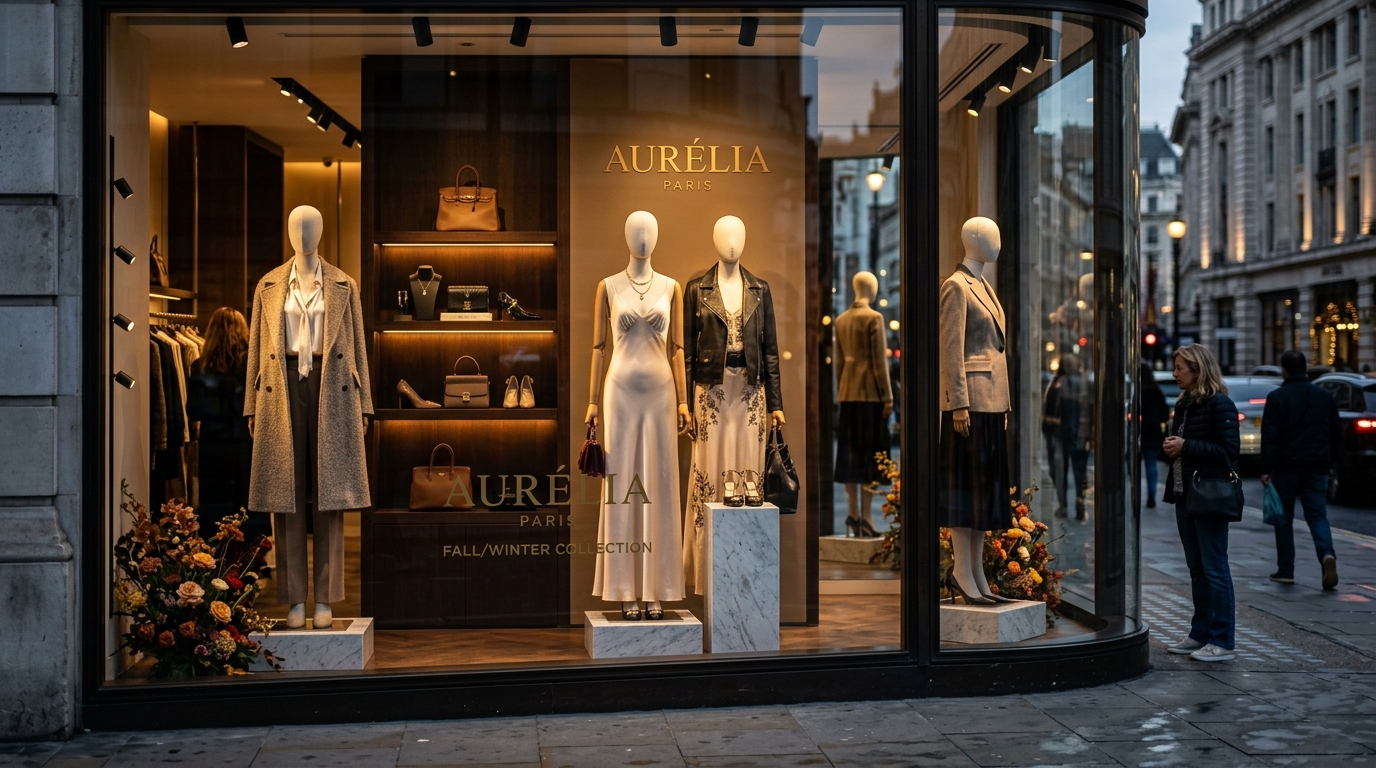
Chapitre 09 - Visual Merchandising
Aménagement du point de vente, vitrines et mise en scène des produits dans un contexte professionnel anglophone.
Reading Comprehension
Based on the Anthropologie article from Découvrir. Answer in English.
The Anthro Twist: Inside the Making of Anthropologie's Window Displays
Anthropologie's Global Display Director Erika Lavinia reveals how the brand transforms everyday inspiration into immersive, show-stopping window installations.
Modern consumers are fickle, slinking between brands to search for inspiration and new products. When consumers lack rigid brand loyalty, a generic, uninspired storefront can quickly fade into the background. Conversely, an elevated, beautifully lit window display creates an immediate lifestyle narrative that can capture attention and foot traffic on the spot.
Perhaps no retailer better illustrates the power of visual storytelling than Anthropologie. The brand has built a reputation for transforming its storefront windows into immersive works of art, creating larger-than-life installations that stop passersby in their tracks and invite them into the brand's world.
But while customers see the finished product, they rarely see what happens behind the scenes. Each display begins as a spark of inspiration before evolving through months of brainstorming, prototyping, problem-solving, and collaboration between home office teams, merchandisers and in-store artists.
"For me, the most successful displays sit at the intersection of artistry and purpose. They create a sense of wonder, but they also help communicate what Anthropologie is all about."
- Erika Lavinia, Global Display Director, Anthropologie
Given how elaborate and eye-catching Anthropologie's displays are, it's almost hard to believe that these grandiose visual installations began as simple ideas inspired by everyday moments - a memorable trip, an art exhibition, a walk in the woods. "Story is always the most important ingredient," said Lavinia. "When we tell a visual story that captures someone's imagination, creates a sense of wonder, or simply makes them smile, I consider that a success."
Once inspiration strikes, concepts are translated into digital renderings before moving into material exploration and physical prototyping - a process that can take weeks. "We build, critique, refine and push ideas further, always asking how we can make the experience richer, more beautiful, and more complete," Lavinia explained. "It's a process rooted in curiosity and craftsmanship."
Empowering store artists
Anthropologie doesn't ship finished displays to stores. Instead, it provides in-store display artists with the vision, detailed instructions and renderings, then invites them to bring it to life within their own space. "Every store has its own architectural personality," said Lavinia, "so a display that works perfectly in one location may need to be reimagined in another."
Without a direct line connecting a display to a purchase, Lavinia noted that influence can manifest in different ways. "We often say that the window display is like the cover of our store 'catalog'. If we've done our job well, it sparks curiosity, creates an emotional connection, and invites someone to turn the page and explore what's inside."
While Anthropologie's window displays may appear effortless to shoppers passing by, they're anything but - behind every installation is a team of creatives, merchandisers and store artists working together to transform a simple idea into something memorable.
Source : RetailTouchPoints.com - Kelly Lindenau, June 2026 · Level: B1/B2
1 According to Erika Lavinia, what is the most important ingredient of a successful display?
2 True or False - then justify in one sentence.
"Anthropologie designs each display centrally and ships the finished installation, ready-made, to every store."
3 What does Lavinia mean when she compares the window display to "the cover of our store 'catalog'"? (2-3 sentences)
4 Why does the same seasonal concept need to be reimagined differently in each store?
5 In your own words, explain why Anthropologie's approach to window displays goes beyond simply "decorating a window."
Grammar Spotlight - Comparatives & Superlatives
Observe → Comprends → Applique.
Observe
These sentences come directly from the Anthropologie and Selfridges articles. What do you notice about the underlined-style words?
The Rule
Short adjectives (1 syllable, or 2 syllables ending in -y): add -er / -est.
Long adjectives (2+ syllables): use more / the most + adjective.
Irregular forms must be learnt by heart.
To express equality, use as + adjective + as: "This display is as eye-catching as the previous one."
| Adjective | Comparative | Superlative |
|---|---|---|
| rich | richer | the richest |
| beautiful | more beautiful | the most beautiful |
| big | bigger | the biggest |
| good | better | the best |
Exercice A - Complete with the correct form
Rewrite each sentence using the comparative or superlative form of the adjective in brackets.
Base: Anthropologie's windows are eye-catching. Its competitors' windows are eye-catching too, but less so. (eye-catching)
Base: Among all the displays of the season, the waterlily window was impressive. (impressive)
Base: This year's holiday windows are good. Last year's were good too, but not as much. (good)
Base: The Disney Castle is a big installation Selfridges has featured in more than 50 years. (big)
Exercice B - Gap-fill
Complete each sentence with the correct comparative or superlative form of the verb in brackets.
A closed display gives _______ (much) focus to the product than an open display, which lets shoppers see into the shop.
Of the three types of window display, the semi-closed display is often considered the _______ (versatile), since it balances product focus and natural light.
According to Erika Lavinia, the _______ (important) ingredient of any display is always the story behind it.
Lexis in Action
Match, classify, and use the key vocabulary from this chapter.
A Matching - Term → Definition
Match each term with the correct definition using the dropdown. Each definition is used once.
B Gap-fill - Complete the sentences
1. An __________ window is one that immediately grabs the attention of people walking by.
2. Anthropologie's __________ for December featured oversized, floating holiday ornaments.
3. A retailer measures the success of a display partly through __________ - likes, shares, comments and visits inspired by the window.
4. Many __________ stop to take photos of Selfridges' Christmas windows before even entering the store.
Guided Writing Task
Mobilise everything you've learnt to describe a real brand's visual merchandising strategy.
Choose a store or brand you know well (Zara, IKEA, Sephora, Nike, Apple, Decathlon…). Write 80-100 words in English to describe its visual merchandising strategy - its window displays, in-store layout, or seasonal installations. Use at least one comparative and one superlative.
Sentence Starters (optional support)
Word Bank
Your Writing
Self-evaluation Checklist
Tick each box once you're satisfied.
Zara is known for having one of the simplest yet most effective visual merchandising strategies in fast fashion. Its window displays are minimalist: usually only two or three mannequins, styled with a single complete look, stand against a plain background. This makes the display far cleaner than most competitors' windows, which are often filled with multiple products. By keeping storefronts uncluttered, Zara draws attention directly to the clothes rather than to decoration - the result is a more sophisticated, boutique-like image for a brand that changes collections faster than almost any other retailer.